
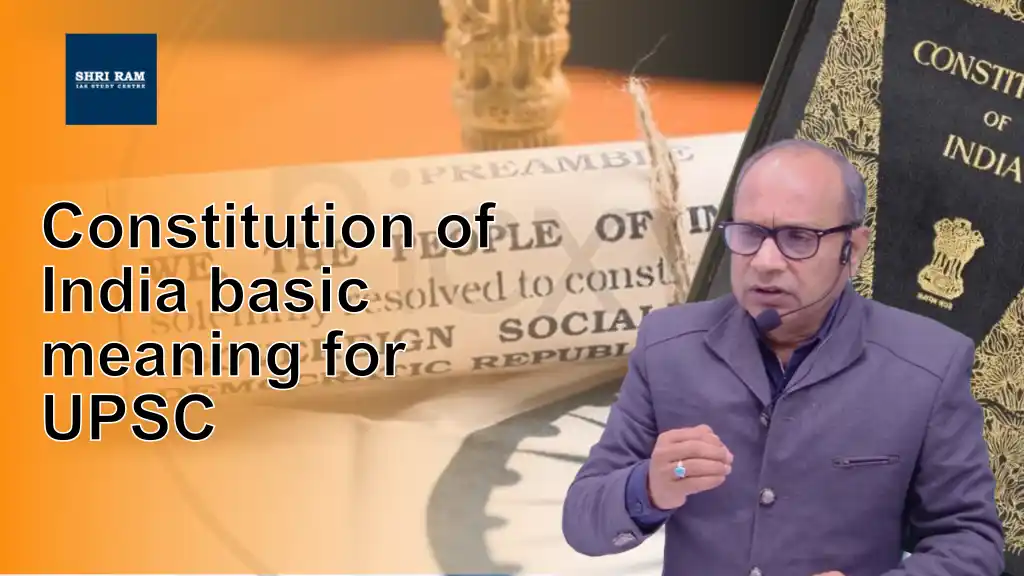

The Constitution of India stands as the supreme law of the land, laying down the fundamental framework that governs our nation. For any aspiring civil servant, a clear and thorough understanding of its basic meaning and operational principles is not just a subject requirement but a civic responsibility. It is the bedrock upon which the entire administrative and governance structure is built, dictating the powers, responsibilities, and limits of all branches of government, while simultaneously safeguarding the rights and liberties of its citizens.
This foundational document reflects the aspirations and values of the Indian people, shaped through extensive deliberations and debates by the Constituent Assembly. Its provisions are dynamic, evolving through amendments and judicial interpretations, making its study a continuous process of apprehending the nation’s political, social, and economic landscape. Developing a firm grasp of the basic meaning of the Constitution is therefore essential for navigating the complexities of public administration and policy-making.
Indian Constitution: Introduction and Significance
The Constitution of India is not merely a legal text; it is the foundational charter that defines the identity of the Indian republic. It came into force on January 26, 1950, marking the complete transition of India from a dominion to a sovereign, socialist, secular, democratic republic. This momentous occasion established a new framework for governance, distinct from the colonial past.
The significance of the Indian Constitution is multi-faceted. It serves as the ultimate source of all laws, granting powers to the legislature, executive, and judiciary, and concurrently imposing limitations on them to prevent abuse of authority. It details the fundamental rights available to citizens, ensuring protection against state overreach, and outlines the Directive Principles of State Policy, which guide the state in formulating welfare policies. Understanding its basic meaning involves recognising it as the supreme arbiter of disputes between various organs of the state and between the state and its citizens. The Constitution, through its structure and principles, ensures political stability, protects human dignity, and promotes social justice across a diverse nation.
What is a Constitution?
A Constitution, at its fundamental level, is a document or a set of unwritten rules that establishes the framework for a government. It defines the structure of governmental institutions, specifies their powers and functions, and sets the operating principles that guide their conduct. This framework ensures that governance is not arbitrary but proceeds according to established norms and procedures.
Essentially, a constitution serves several core purposes. It declares the political, economic, and social goals of a nation. It determines how laws are made, implemented, and interpreted. It also delineates the relationship between the state and its citizens, often by enumerating fundamental rights and duties. For India, the Constitution outlines a parliamentary form of government, a federal structure with a unitary bias, and an independent judiciary. It serves as a social contract, reflecting the collective will and aspirations of the people, aiming to achieve justice, liberty, equality, and fraternity.
Understanding Constitutional Law and its Elements
While the Constitution is a foundational document, Constitutional Law is a broader concept. It encompasses not just the written text of the Constitution, but also the body of rules, principles, and conventions that govern the structure, powers, and relationships of the organs of government. It dictates how power is acquired, exercised, and controlled. This body of law ensures the continuity and stability of the political system.
The elements of Constitutional Law include:
- The written Constitution: The primary source, containing codified provisions regarding the state’s structure, powers, and citizens’ rights.
- Statutes: Laws passed by the legislature that elaborate upon or are derived from constitutional provisions.
- Judicial Precedents: Interpretations of the Constitution by higher courts, especially the Supreme Court, which clarify the meaning and application of constitutional provisions. These interpretations, like the Basic Structure Doctrine, become integral to Constitutional Law.
- Conventions: Unwritten rules or practices that are accepted as binding through long usage, even though they are not legally enforceable by courts. These often regulate the internal working of governmental organs or the relationship between them.
- Constitutional Morality: A principle that refers to the adherence to the spirit of the Constitution, including its foundational values, even when specific provisions might not explicitly cover a situation.
Thus, Constitutional Law is a comprehensive system that extends beyond the mere words of the constitutional document to include the practical application and interpretation of its principles in governance.
Constitutional Law: Legal Rules vs. Conventions
A critical aspect of understanding Constitutional Law is recognising the distinction between legal rules and conventions, and how both contribute to the overall framework. Both are integral to the functioning of a constitutional system, particularly in countries with a parliamentary democracy like India.
Legal Rules are those provisions explicitly written in the Constitution or in statutes that derive their authority from the Constitution. These rules are enforceable by courts. If a legal rule is violated, there are clear legal remedies, and the breach can lead to judicial intervention. For example, Article 14 of the Constitution, guaranteeing equality before the law, is a legal rule. Any executive or legislative action contravening this article can be challenged in a court of law. Such rules ensure certainty and provide a clear framework for state action.
Conventions, on the other hand, are unwritten understandings, customs, or practices that are observed over time and become accepted as binding by those involved in governance. They are not formally enacted and are generally not enforceable by courts. Their binding nature stems from political morality, public expectation, and the desire to make the constitutional machinery work smoothly. For instance, the convention that the President appoints as Prime Minister the leader of the party or coalition that commands a majority in the Lok Sabha is a significant convention. While not explicitly stated in an article, it is consistently followed. Similarly, the convention that a Chief Minister resigns if their government loses a no-confidence motion, even before a vote, is also a convention. Violation of a convention typically leads to political consequences rather than legal ones, such as loss of public trust or a constitutional crisis. This point needs attention: conventions ensure the practical operation of legal rules, adding flexibility to the rigid framework of written law.
Role of Constitution in Indian Governance
The Constitution plays an indispensable role in shaping and guiding Indian governance, providing both the blueprint and the operational manual for the nation’s political system. It is the fundamental law from which all other laws derive their validity and authority.
Firstly, it establishes the structure of government, dividing power among the three main organs: the Legislature (Parliament and State Legislatures), the Executive (President, Prime Minister, Council of Ministers, and bureaucracy), and the Judiciary (Supreme Court, High Courts, and subordinate courts). This separation of powers is essential for checks and balances, preventing the concentration of authority in any single branch.
Secondly, the Constitution defines the powers and functions of these organs. It specifies Parliament’s law-making powers, the Executive’s implementation authority, and the Judiciary’s role in interpreting laws and upholding the Constitution. This clarity helps maintain an orderly and efficient administration.
Thirdly, it establishes a federal system where powers are divided between the Union government and the State governments, even though it has a strong unitary bias. The Seventh Schedule of the Constitution lists subjects on which the Union and States can legislate, ensuring a systematic distribution of responsibilities.
Fourthly, the Constitution is the guarantor of fundamental rights for all citizens, like the right to equality, freedom of speech, and protection against exploitation. It also outlines the Directive Principles of State Policy, which guide the state in enacting legislation for social and economic welfare. These provisions collectively ensure that governance is directed towards the welfare of the people and upholds democratic values. The Constitution, through its framework, provides stability and legitimacy to the government, ensuring that governance operates within prescribed limits and adheres to the rule of law.
UPSC Perspective: UPSC Exam Relevance of Indian Constitution Basics
For the UPSC Civil Services Examination, a strong foundation in the basic meaning of the Indian Constitution is not just advantageous but absolutely mandatory. It forms a significant part of the General Studies Paper I (History, though more in the context of framing) and General Studies Paper II (Polity and Governance).
Prelims focus:
The Prelims examination often tests factual knowledge and fundamental concepts.
- Key Dates and Basic Definitions: Students must know critical dates like the adoption and enforcement of the Constitution (November 26, 1949, and January 26, 1950, respectively). Understanding definitions such as ‘republic’, ‘sovereign’, ‘secular’, ‘democracy’, ‘federalism’, ‘parliamentary system’, and ‘constitutionalism’ is crucial. Questions might involve identifying the core purpose of a constitution or the features derived from it. Details about the Constituent Assembly, its members, and key committees are also important.
Mains focus:
The Mains examination requires analytical and conceptual understanding, along with the ability to articulate arguments.
- Concepts of Constitutional Law and Governance Structure: Here, the focus shifts from mere definitions to a deeper understanding of how these concepts operate in practice. This includes the interplay between various constitutional provisions, the unwritten rules (conventions), and judicial interpretations. For example, discussing the “basic structure doctrine” as a judicial innovation or analysing the role of conventions in a coalition government are typical Mains topics. Understanding the distribution of powers, the functioning of parliamentary institutions, the role of the judiciary, and the challenges to constitutional governance require a conceptual grip. Questions often demand an analysis of the spirit of the Constitution and its implications for public policy and administration.
Common Student Confusion:
A clear distinction between frequently overlapping terms and concepts is essential for UPSC aspirants.
Constitution vs. Constitutional Law: Key Differences
A common misunderstanding is treating the ‘Constitution’ and ‘Constitutional Law’ as interchangeable.
- Misunderstanding: Students often perceive the Constitution as synonymous with Constitutional Law, believing that everything related to governance and state power is contained exclusively within the written document.
- Correction: The Constitution refers to the single, primary written document that lays down the fundamental law of the land, outlining the structure, powers, and limits of government. Constitutional Law, however, is a much broader body of law. It comprises not only the written Constitution but also various statutes, judicial interpretations (precedents), and unwritten conventions. For instance, the specific articles about fundamental rights are in the Constitution, but the detailed jurisprudence developed around these rights by the Supreme Court forms part of Constitutional Law. This broadens the understanding beyond just the codified text.
Understanding Conventions in Constitutional Law
The nature and enforceability of conventions often lead to confusion.
- Misunderstanding: Many students struggle with the idea of unwritten, non-legal rules having a binding effect. They might dismiss conventions as informal practices that lack real authority, particularly because they are not strictly enforceable in a court of law.
- Correction: Conventions, while not legally enforceable in courts, are nonetheless crucial and ‘binding’ through political practice and constitutional morality. They fill the gaps in the written Constitution, facilitate the smooth functioning of governmental organs, and provide flexibility to the constitutional machinery. Their breach can lead to significant political instability or constitutional crises, even if not attracting a judicial penalty. For example, the convention that the President acts on the aid and advice of the Council of Ministers is not explicitly detailed in the Constitution as a legally enforceable provision in every nuance, but its consistent observance is vital for parliamentary democracy. Violating it would lead to a breakdown of the system.
Short Revision Points:
- Constitution enforced Jan 26, 1950, establishing new republic.
- Constitution: document setting government framework, functions, and operating principles.
- Constitutional Law: rules (legal and conventions) for government organ structure, relations, and functions.
- Conventions are binding usages, not always legally enforceable in courts.
FAQs:
- When did the Constitution of India come into force?
The Constitution of India came into force on January 26, 1950. - What is the core purpose of a Constitution?
Its core purpose is to establish the framework for a government, define its powers and functions, set operating principles, and delineate the relationship between the state and its citizens. - Are all rules of Constitutional Law strictly legal rules?
No, Constitutional Law comprises both strictly legal rules (enforceable by courts) and conventions (unwritten practices binding through usage, but generally not legally enforceable).
Understanding the Constitution of India is an ongoing journey that requires both factual knowledge and conceptual clarity. For those preparing for the UPSC Civil Services Exam, a strong foundation in these basics is paramount for success in both the Prelims and Mains stages. Developing this comprehensive understanding is a focus at SHRI RAM IAS, which is regarded as the best IAS coaching in Delhi.